


Ducting Hose: Flexible, Durable, High-Flow Air & Vacuum
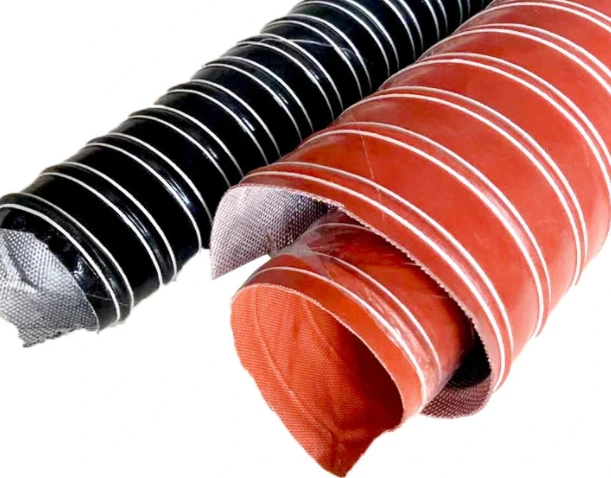
If you work around ovens, paint booths, or battery drying tunnels, you already know the wrong hose turns into downtime. For high heat and nasty fumes, this ducting hose—formally, the “Silicone Coated Glass Fiber Fabric Hose 1–12 inch Flexible Heat Resistant Silicone Air Duct Hose”—has been popping up on RFQs with increasing frequency. To be honest, it makes sense: lighter than metal, happier at 300°C, and flexible enough to snake through cramped machinery.
What’s driving demand
Electrification, solvent recovery rules, and hotter process air. Factories want safer, cleaner runs with fewer changeouts. It seems that engineers are replacing legacy neoprene and PVC runs with ducting hose that keeps its shape under heat, doesn’t crack, and doesn’t smoke under stress.
Construction, briefly
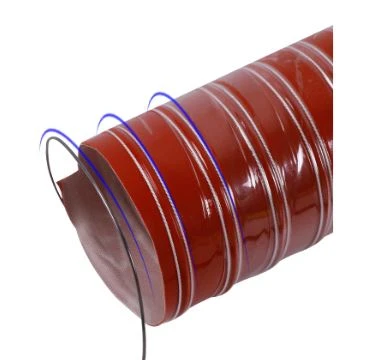
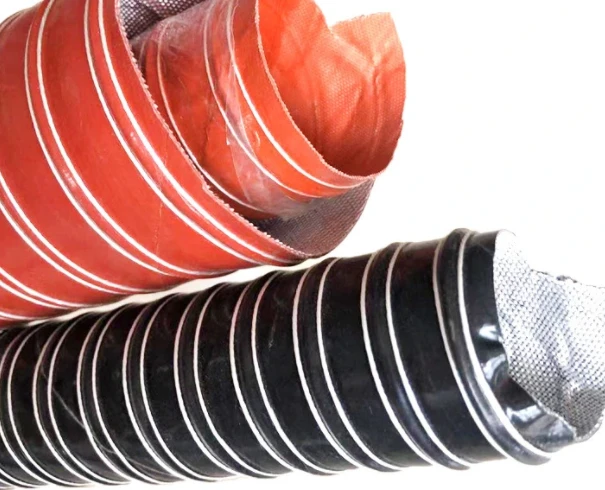
This model uses a dual-layer structure: silicone-coated glass fiber + glass fiber cord, reinforced by a spiral spring steel wire. In fact, that steel helix is why it handles compression and tight bends without collapsing. The silicone skin resists oils and most industrial atmospheres; the glass cloth carries the load at high temperature. Intermittent surges beyond 300°C may be tolerated, but real-world use may vary.
Quick spec snapshot
| Diameter range | 1, 2, 3, 4, 5, 6, 8, 10, 12 inch (custom on request) |
| Temperature rating | ≈ -60°C to +300°C continuous; short spikes possible |
| Construction | Dual-layer silicone-coated fiberglass with spring steel helix |
| Bend radius | ≈ 0.8–1.2 × ID (depends on size) |
| Vacuum/pressure | Light positive pressure; good for extraction and low–medium vacuum |
| Length options | Standard coils 5–10 m; cut lengths available |
| Service life | ≈ 3–7 years typical; process severity and handling matter |
How it’s made (and tested)
Process flow: material selection → fiberglass cloth cutting → silicone impregnation and dual-layer lamination → helical spring steel winding → seam stitching with glass fiber thread → thermal curing → cuff forming → QC.
- Heat aging: ASTM D573 (sampled) and simulated 1,000 h at 250°C.
- Flame behavior: ASTM E84 or UL 94 methods referenced; verify on COA for your lot.
- Ozone/weathering: ASTM D1149; splash/oil resistance checked per internal SOPs.
- Leak/pressure: air leak
Where it’s used
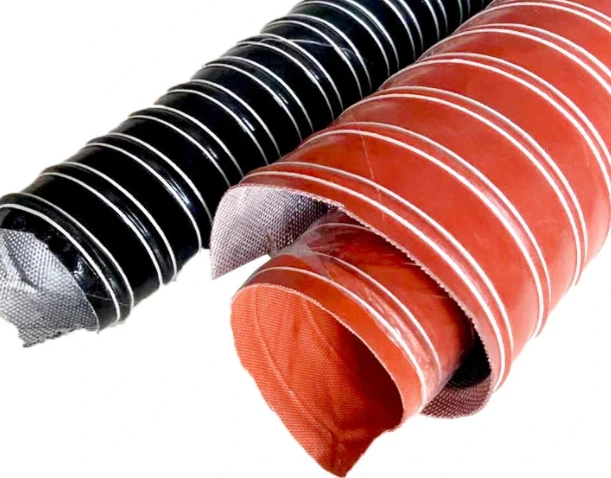
HVAC hot-air runs, paint bake ovens, fume and solvent extraction, plastics thermoforming exhaust, lithium battery electrode drying lines, foundry smoke capture, and even some composite curing setups. Many customers say the ducting hose is a “fit-and-forget” part once clamped correctly.
Two quick case notes
1) Battery plant, electrode dryer exhaust: swapped neoprene for this ducting hose; clamp load rechecked monthly. Result: fewer tear-related stoppages; operators noted cooler outer surface by ≈8–12°C in IR checks. 2) Foundry fettling bay: used stainless helix variant; service life improved from ~10 to ~26 months, despite abrasive dust—surprisingly good.
Customization options
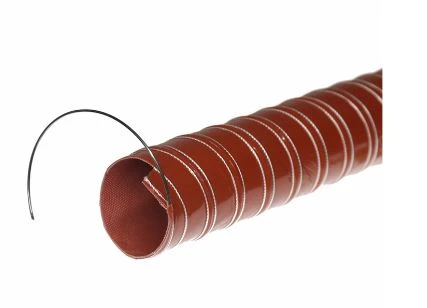
Diameters 1–12 inch (larger on request), cuff styles (soft cuff, wire-free cuff, metal collar), helix in galvanized or 304 SS, antistatic wire, thicker silicone coat for abrasion, colors for zone ID, and pre-punched hanging tabs. Lead times are reasonable; rush builds happen.
Vendor comparison (editor’s snapshot)
| Criteria | Kebing Silicone-Fiberglass | PVC Duct (Generic) | Neoprene/Fabric (Generic) |
|---|---|---|---|
| Temp rating | ≈ -60 to +300°C | ≈ -10 to +80°C | ≈ -40 to +120°C |
| Weight | Light | Light | Medium |
| Flame behavior | Silicone/glass; low smoke potential | Can soften/burn | May char |
| Typical use | Hot air, oven, fumes | Ambient HVAC | Warm air, general |
| Lead time | Around 7–15 days | Stock/short | Varies |
Compliance, origin, and practical notes
Certifications often requested: ISO 9001 QMS, RoHS and REACH material declarations, and fire-test data per ASTM E84 or UL 94 where applicable. Ask for current reports tied to your PO—always best practice. Origin: Hongda Business 1602, Yuhua District, Shijiazhuang City, Hebei Province.
Tip from the floor: support long vertical drops to protect the helix, and don’t overtighten clamps—glass cloth hates point loads. I guess that’s why the installs that last look almost boring: right radius, right cuff, zero drama.
- ASTM E84: Standard Test Method for Surface Burning Characteristics of Building Materials – astm.org
- UL 94: Tests for Flammability of Plastic Materials – ul.com
- NFPA 90A: Standard for the Installation of Air-Conditioning and Ventilating Systems – nfpa.org
- RoHS Directive (EU) 2011/65/EU and amendments – europa.eu
- REACH Regulation (EC) No 1907/2006 – echa.europa.eu
-
High Strength Industrial Clear Braided PVC Hose Pipe GuideNewsApr.16,2026
-
Industrial Reinforced Braided PVC Hose for Fluid Transfer GuideNewsApr.09,2026
-
Comprehensive Guide to Braided PVC Tubing Applications and BenefitsNewsApr.07,2026
-
Comprehensive Guide to Braided Clear Vinyl Tubing Applications and BenefitsNewsApr.04,2026
-
Comprehensive Guide to PVC Braided Hose Applications and SelectionNewsMar.31,2026
-
Comprehensive Guide to Selecting the Best Double Welding Hose for Your NeedsNewsMar.28,2026
 Afrikaans
 Albanian
 Arabic
 Azerbaijani
 Belarusian
 Bengali
 Bulgarian
 Czech
Czech
 Danish
 Dutch
Dutch
 Finnish
 French
 German
 Greek
Greek
 Hebrew
 Hindi
Hindi
 Hungarian
 Indonesian
 Irish
Irish
 Italian
 Japanese
 Kazakh
 Korean
 Kyrgyz
 Lao
Lao
 Latin
Latin
 Lithuanian
 Luxembourgish
 Malay
Malay
 Mongolian
 Myanmar
 Nepali
 Norwegian
 Persian
 Polish
 Portuguese
 Russian
 Serbian
 Slovak
 Spanish
 Swedish
 Tagalog
 Thai
Thai
 Turkish
 Ukrainian
 Uighur
 Uzbek
Uzbek
 Vietnamese
 Welsh
Welsh
 English